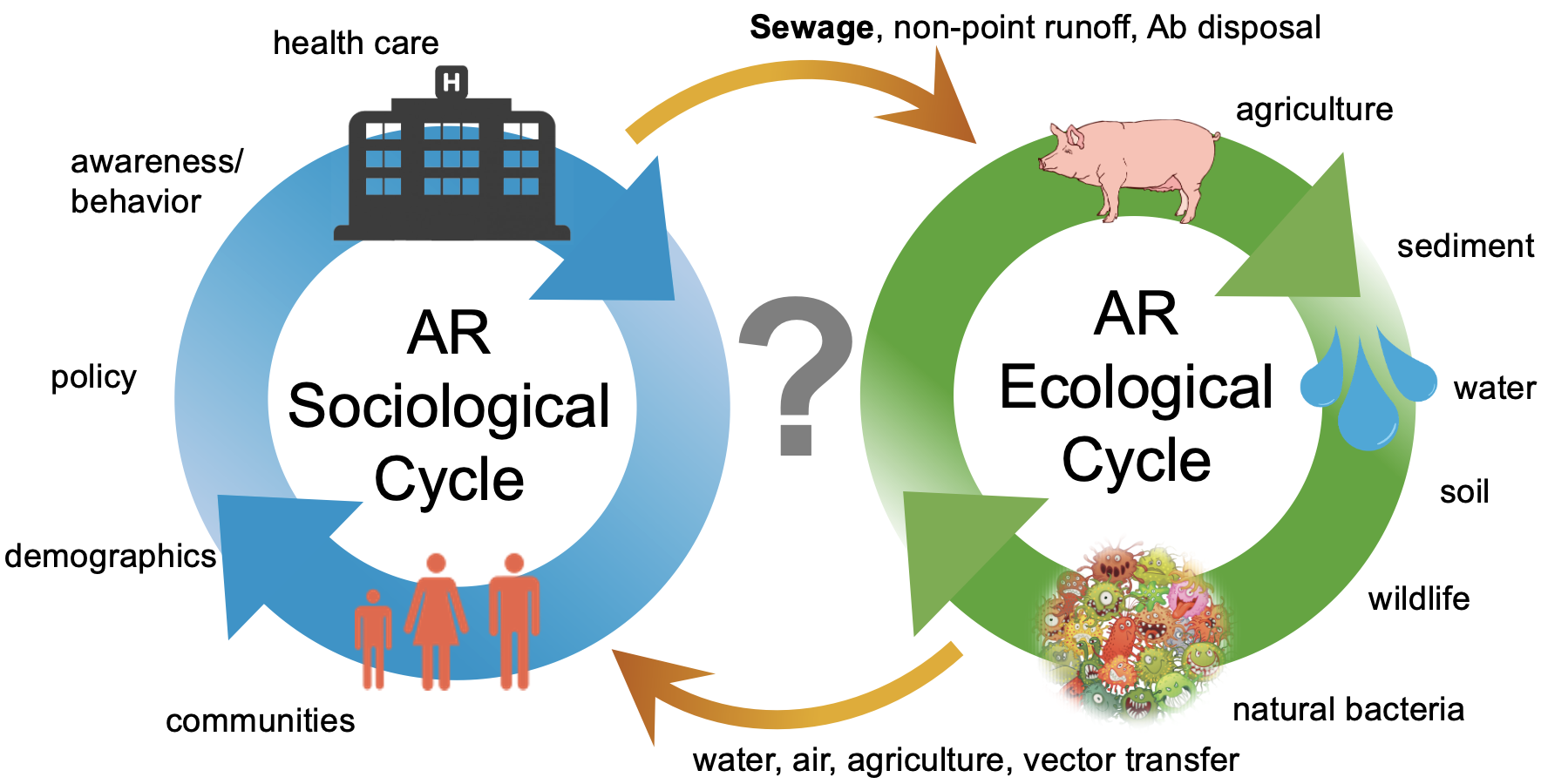
Sociological and Ecological Cycles of AMR
Antibiotic resistance (AR) emerges from the dynamic interaction between human systems and environmental processes. This figure illustrates two interconnected cycles: a sociological cycle, driven by human behavior, healthcare practices, policy, and antibiotic use, and an ecological cycle, where resistant organisms and genes persist and circulate through water, soil, wildlife, and microbial communities.
Wastewater treatment plants (WWTPs) serve as a critical interface between these domains, receiving inputs from diverse human sources and acting as hubs where chemical, physical, and biological processes shape microbial communities. Within these engineered environments, resistance can be attenuated, maintained, or in some cases enriched, depending on treatment conditions and system dynamics. Effluent discharges, biosolids reuse, and environmental transport pathways (e.g., water, air, and agricultural systems) then redistribute resistant organisms and genes into the broader environment. These ecological pathways ultimately reconnect with human populations, completing the cycle.
Our research focuses on understanding this coupled socio-environmental system, with particular emphasis on WWTPs as key control points linking human activity to environmental dissemination. By integrating field sampling, molecular analyses, and data-driven modeling, we aim to identify the drivers of resistance across systems and develop strategies to mitigate its spread at the human–environment interface.